Launch offer — valid today only

📄 Digital book in PDF · read it on your phone or print it

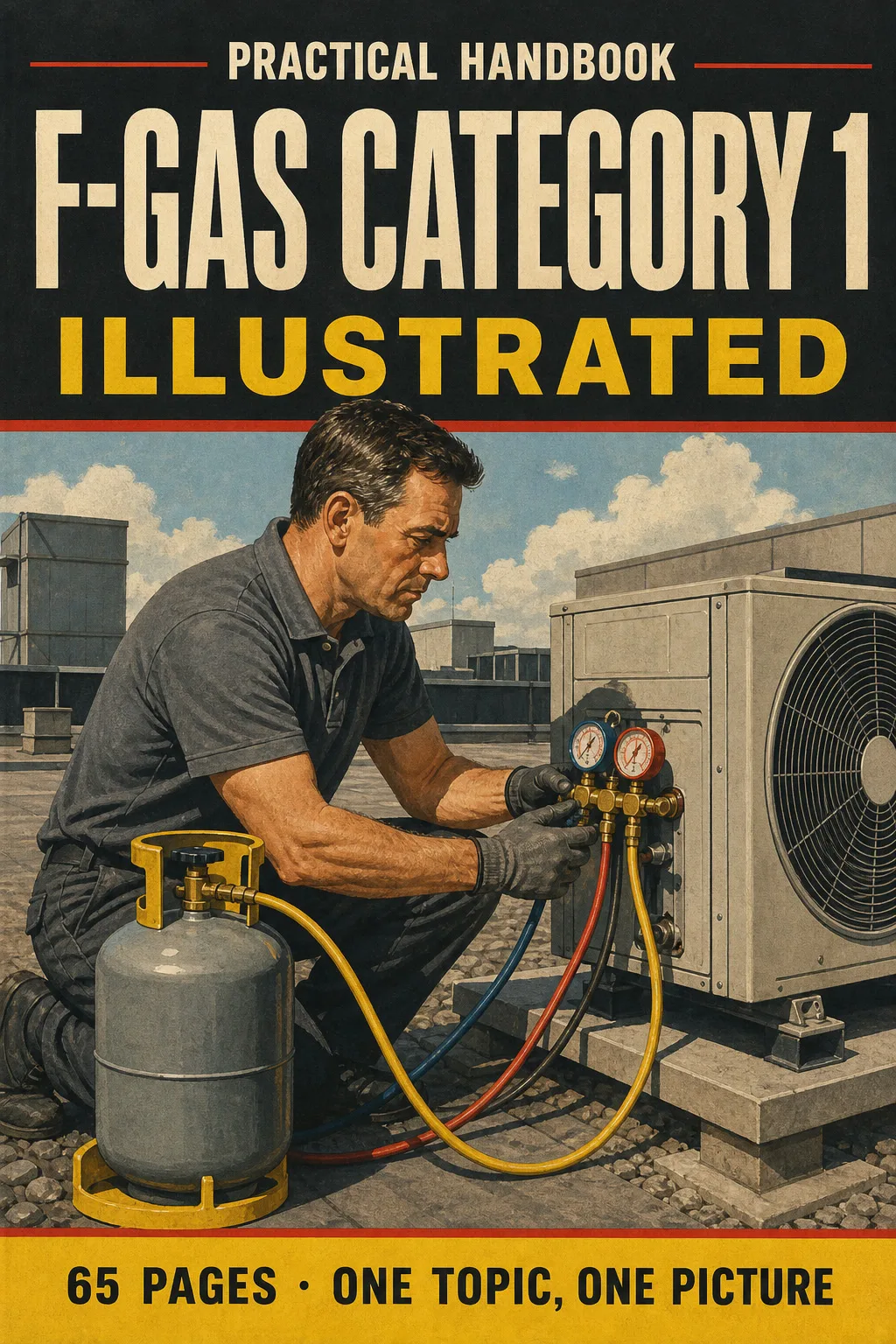
F-Gas Category 1 in Drawings: the Cycle, the Manifold and Superheat in the Same Order Every Time One Topic on Every Page

The refrigeration cycle, the manifold, P-T charts, superheat and subcooling, leak checks, the GB F-gas rules, recovery, vacuum and charging. Every topic has its own page: the drawing first, then what you need to remember. 65 illustrated pages.

START STUDYING THIS WAY

🔒 Secure checkout · PDF by email · 30-day guarantee

Every topic, its own pageEach procedure drawn, with the explanation beside it
65 illustrated pages8 parts, from what Category 1 lets you do to the final checklist for the van
Up-to-date sourcesGB F-gas rules: Reg. 517/2014 as it applies in GB, SI 2015/310, Reg. 2015/2067 and GOV.UK guidance
PDF by emailFormat

Look Inside the Book

Every page has one big drawing and a box with the numbers and steps you need to know:

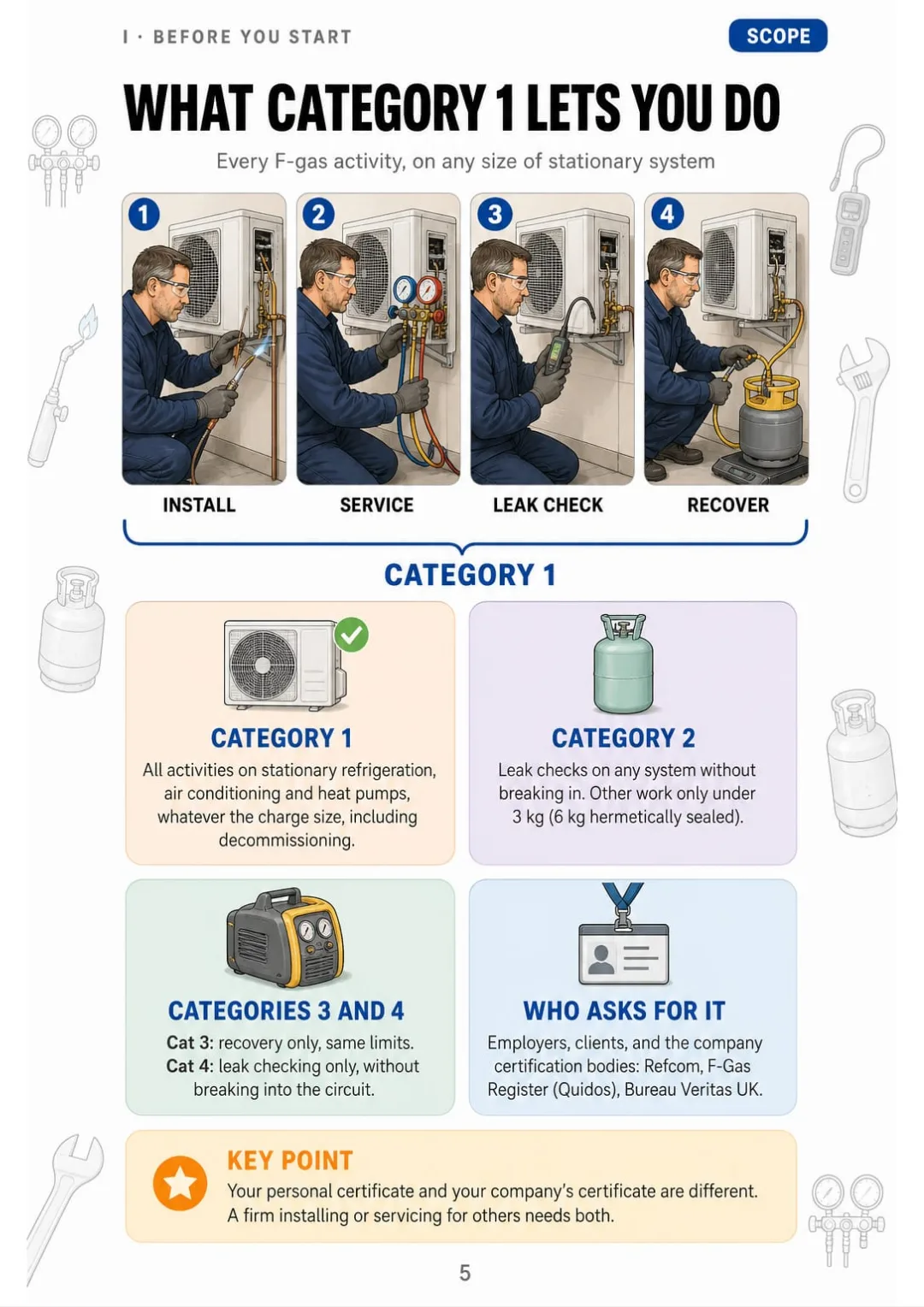
Cat 1: install, service, leak check, recover and decommission, any charge size
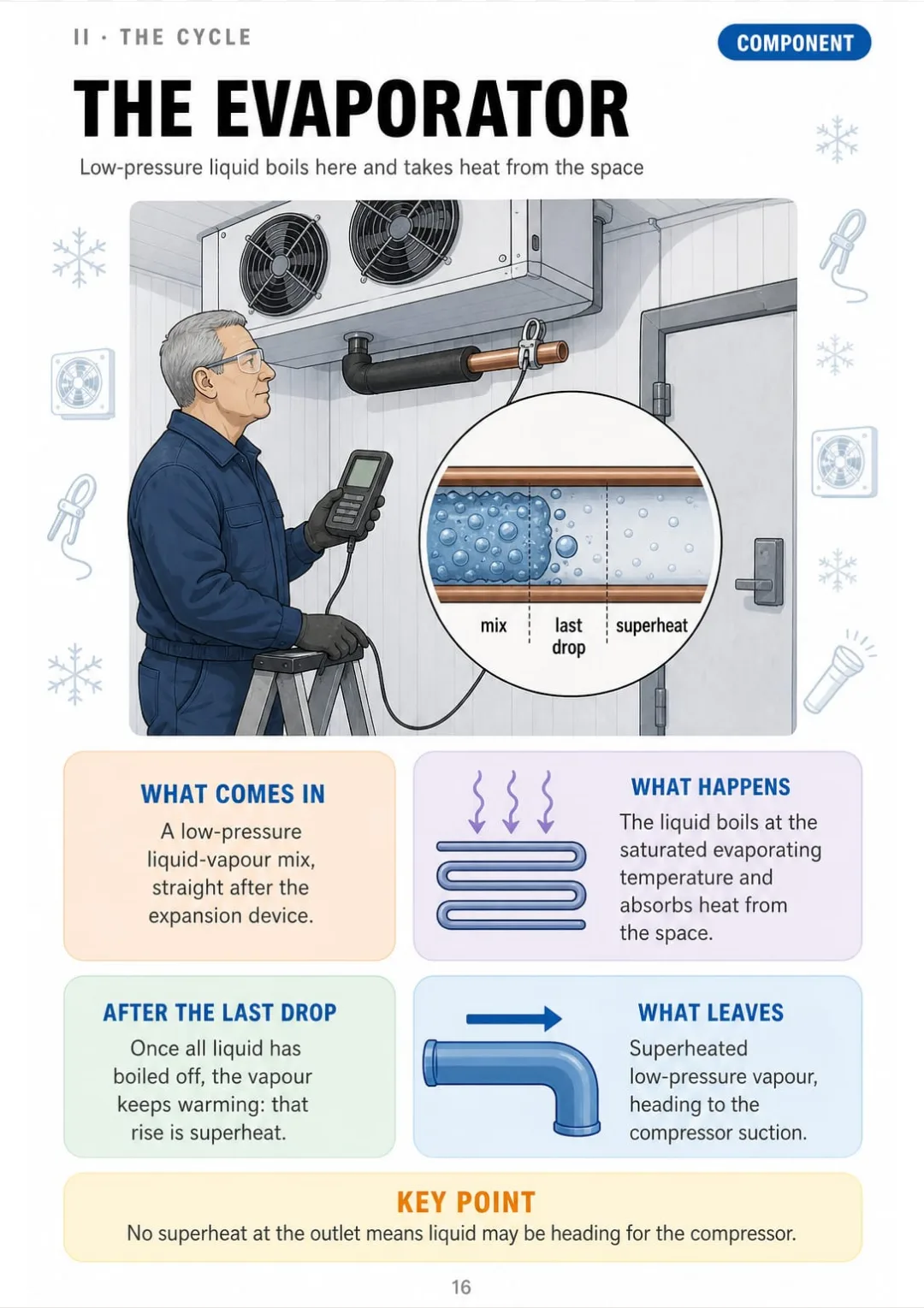
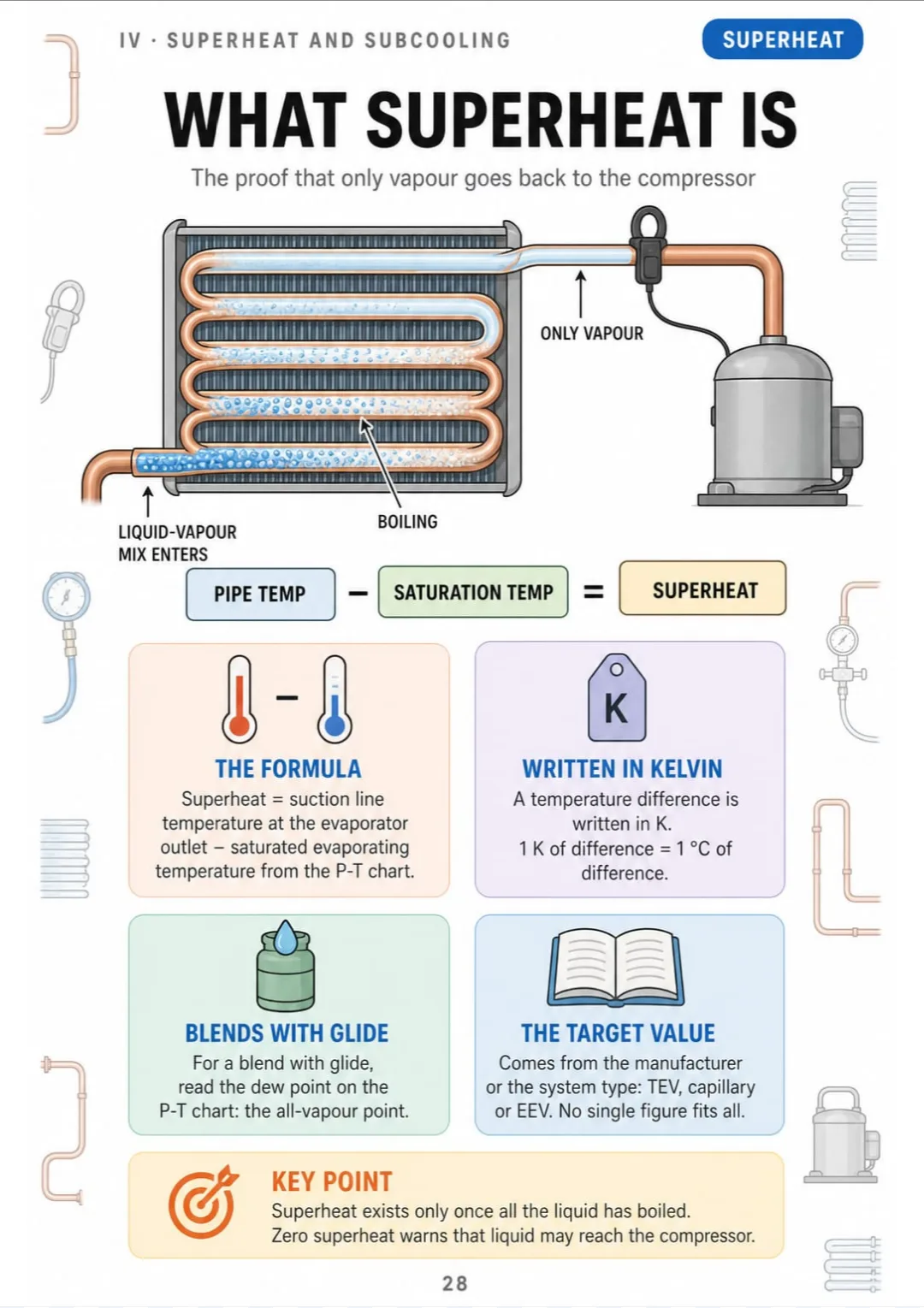
Liquid boils off inside the coil; after the last drop, the vapour picks up superheat.
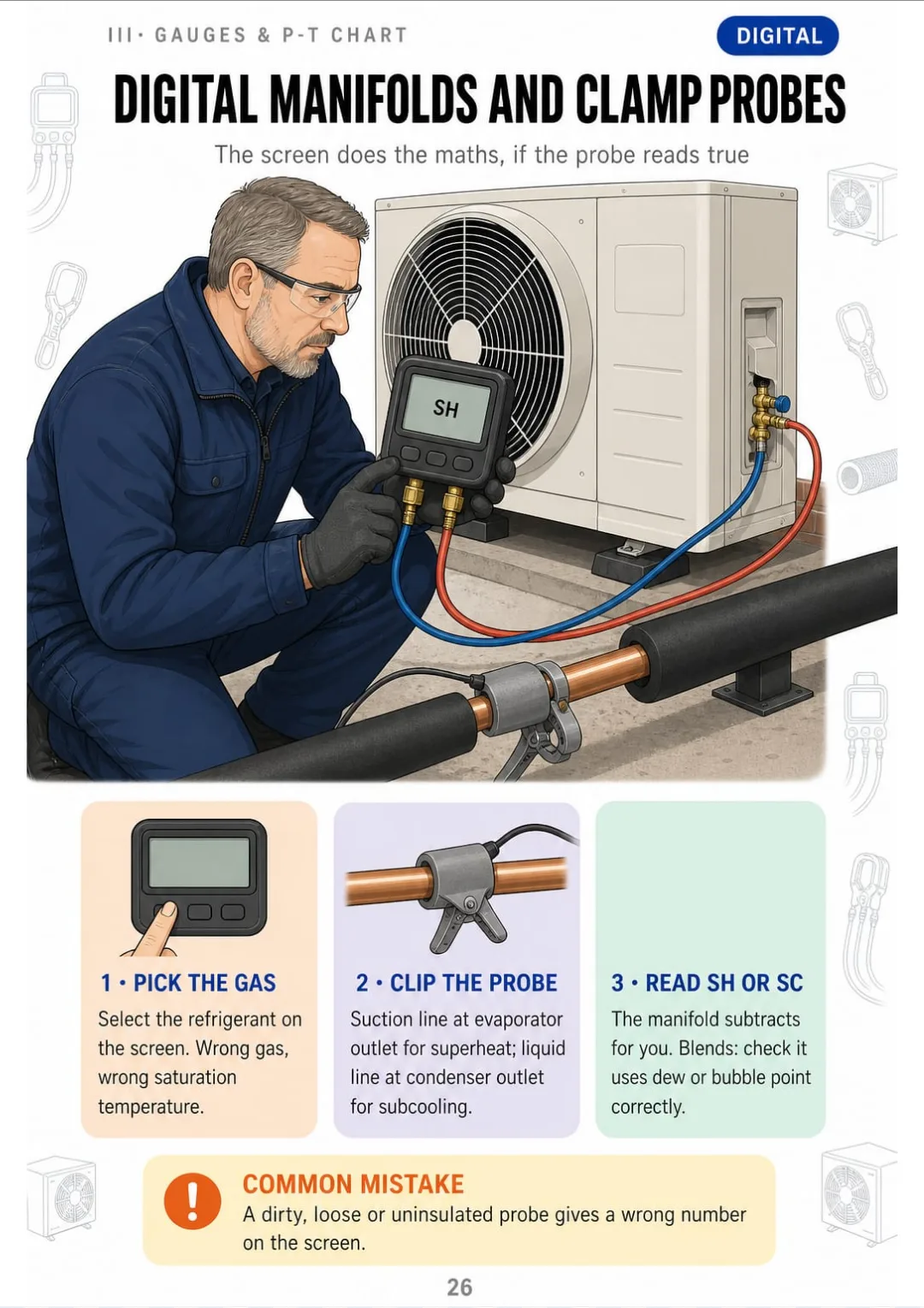
Clean, tight, insulated probe: otherwise the superheat on screen is wrong
Superheat = suction pipe temperature − saturation temperature, written in K
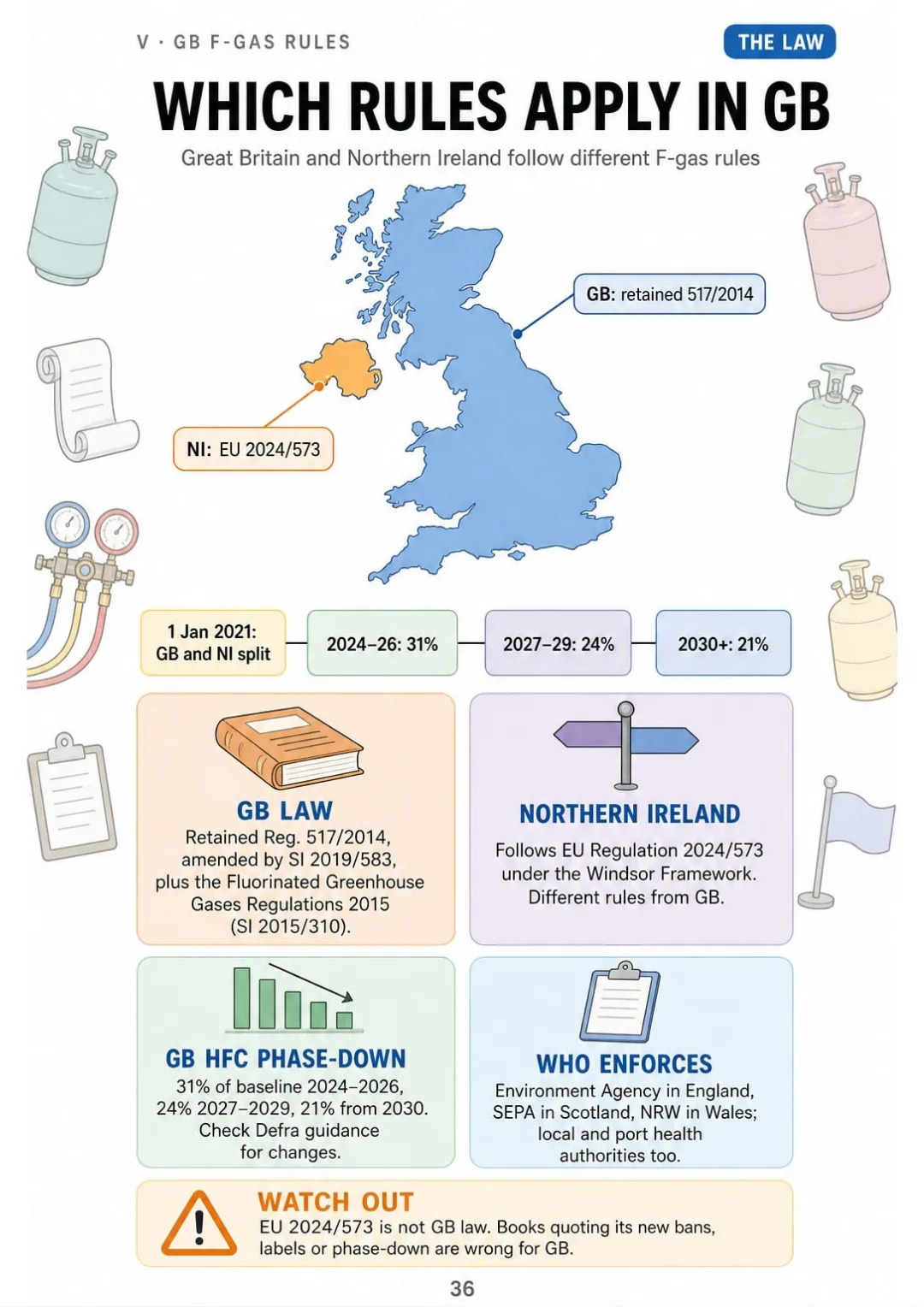
GB: retained Reg. 517/2014 + SI 2015/310 · NI: EU 2024/573
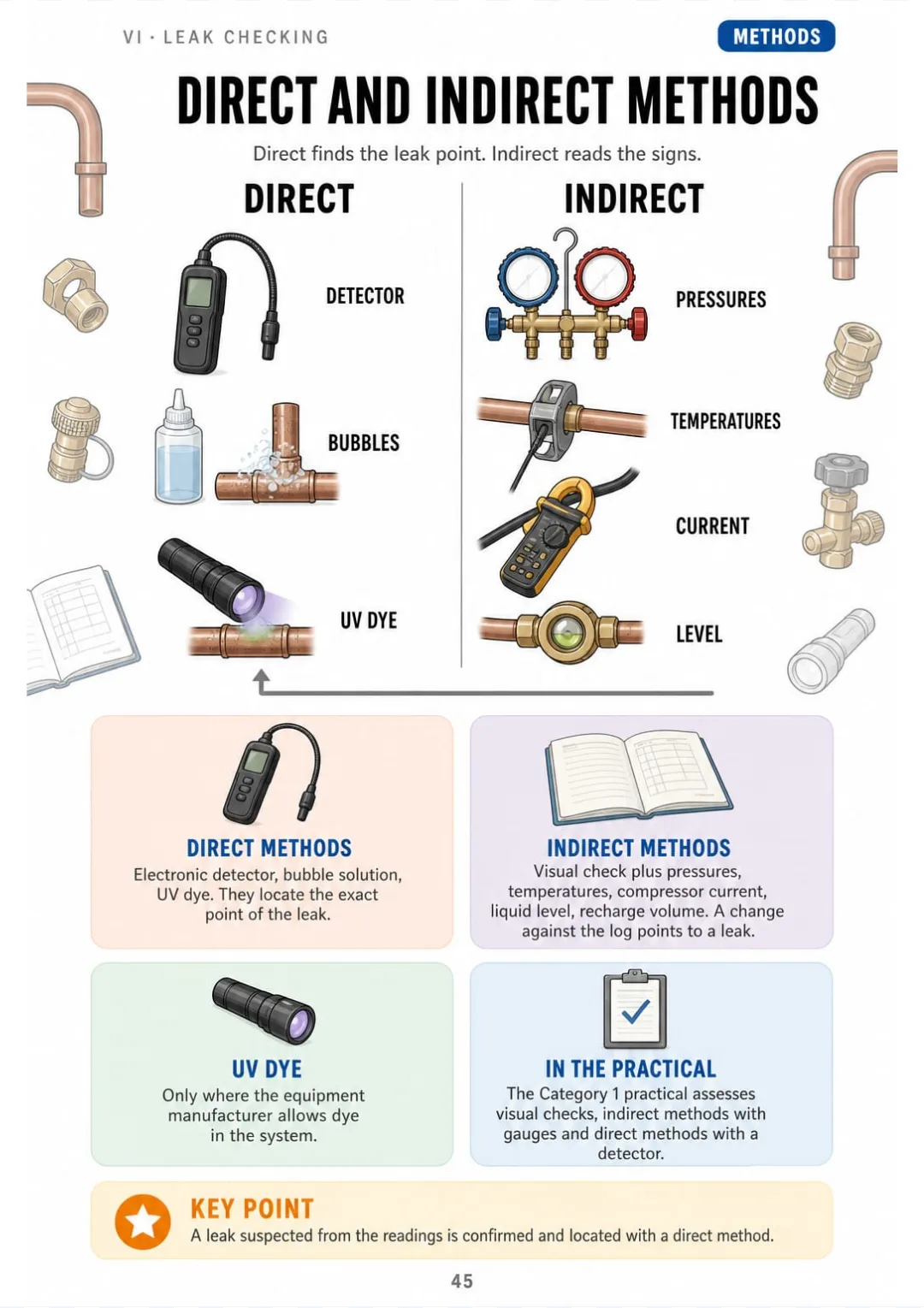
Direct: detector, bubbles, UV dye · Indirect: pressures, temperatures, current, level
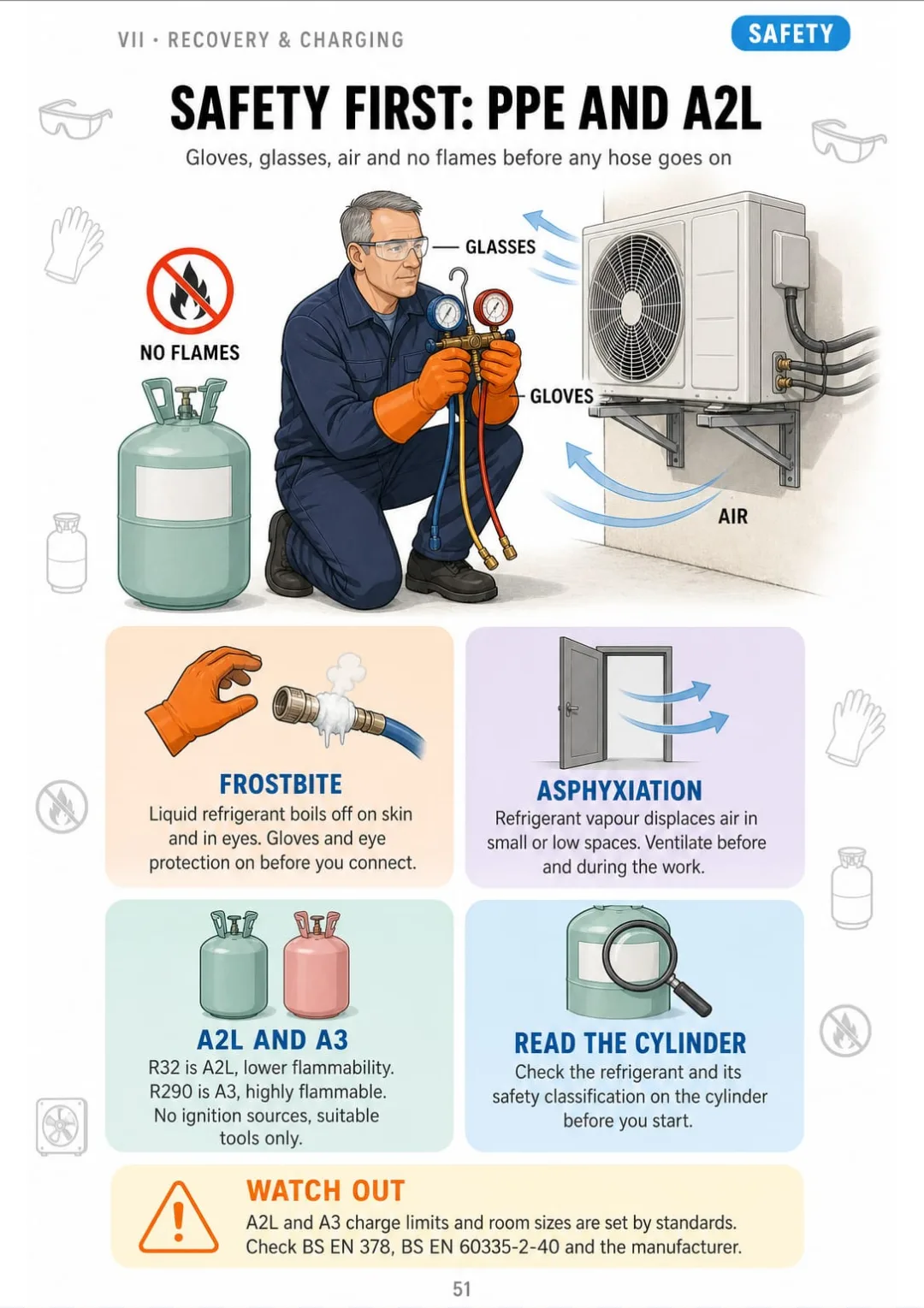
R32 = A2L, R290 = A3: gloves, glasses, ventilation and no ignition sources
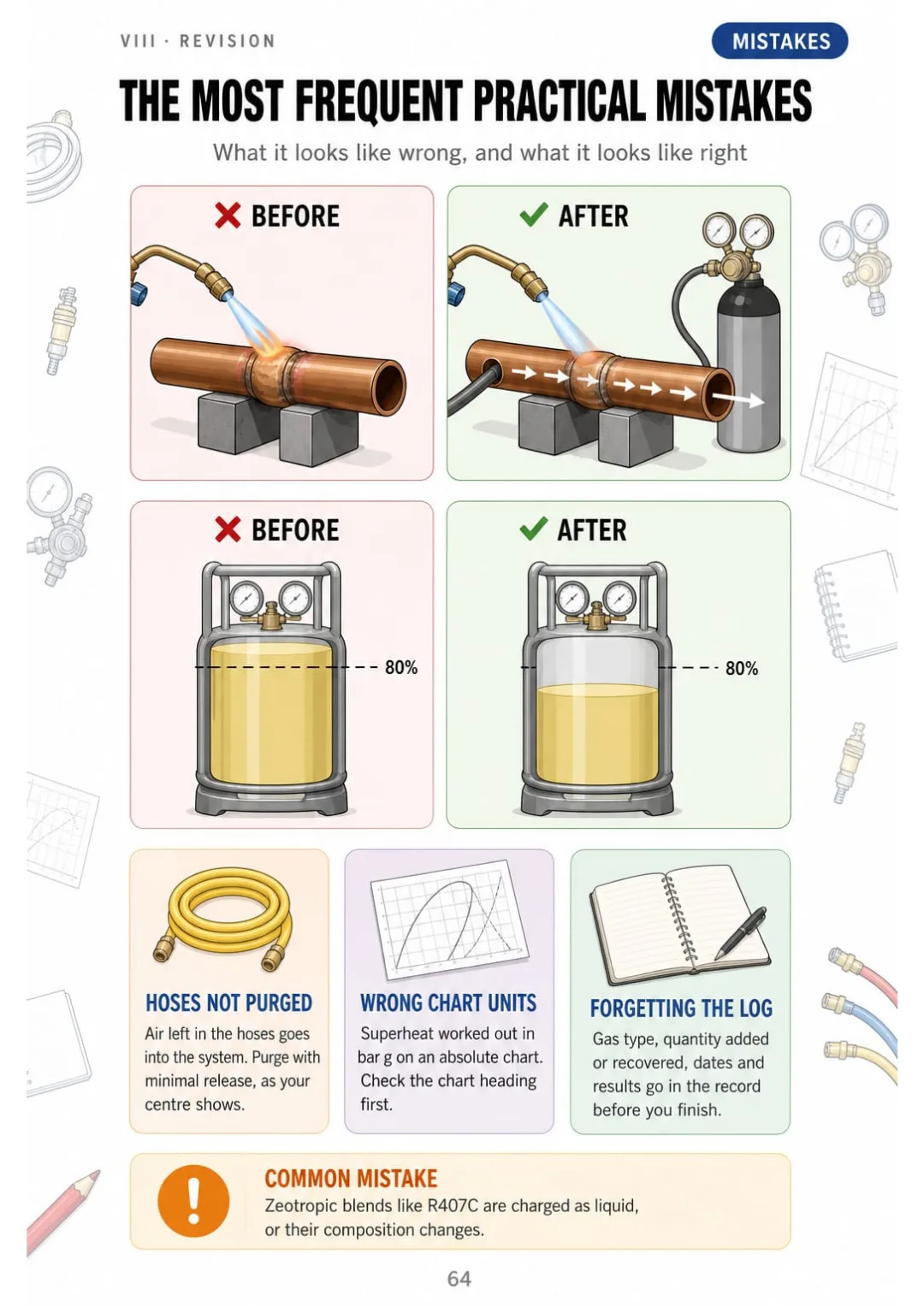
No OFN while brazing, blend as vapour, cylinder over 80%, gauges swapped, bar g vs abs, no log.

Swipe to see more →

These are real pages from the book. The table of contents is the full one: 8 parts and 61 topics.

The Problem Isn't You. It's How It Was Explained.

You're at the practice rig with the manifold in your hand, three hoses hanging loose, and the assessor is waiting for you to connect up.

Blue, red, yellow: you've read it. But the manual covers it in a paragraph about ports, valves and service connections. Words don't tell your hands where each hose goes.

Clean, tight, insulated probe: otherwise the superheat on screen is wrong

In the book, the manifold is one big drawing: blue to the low side (suction), red to the high side, yellow to the pump, cylinder or recovery unit, with every valve labelled.

The same goes for the cycle, the P-T chart, superheat, leak checking and the standing vacuum test: each one has its own page.

You look, it makes sense, and you connect up without going back to the manual.

COMPARE FOR YOURSELF

The Same Topic, Two Ways to Study It

THIS
  • The manual: line after line
  • The cycle explained only in words
  • You reach the assessment with doubts
The vapour-compression refrigeration cycle comprises four principal components connected in a closed circuit. Low-pressure superheated vapour is drawn from the evaporator by the compressor, where it is compressed to a higher pressure and temperature before being discharged to the condenser. Within the condenser, heat is rejected to the surrounding medium, causing the refrigerant to change state from vapour to liquid. The high-pressure liquid then passes through the expansion device, where its pressure is reduced, and enters the evaporator, where heat is absorbed and the cycle recommences.
FOR THIS
  • The cycle in one drawing
  • High side and low side marked in a box
  • Arrows from compressor to evaporator, with the state at each point
Liquid boils off inside the coil; after the last drop, the vapour picks up superheat.
CONTENTS

Take a Look at the 8 Parts and 61 Topics

From the basics to revision for the day itself: the refrigeration cycle, gauges and the P-T chart, superheat and subcooling, the GB F-gas rules, leak checking, recovery, vacuum and charging. 65 pages, all illustrated

IBefore you start · pp. 5-11
  1. What Category 1 lets you do
  2. How the assessment works
  3. Pressure: bar gauge or bar absolute
  4. Temperature differences are in kelvin
  5. Sensible heat and latent heat
  6. Pressure decides the boiling point
  7. Refrigerant families and GWP
IIThe refrigeration cycle · pp. 12-19
  1. The cycle you can follow with your finger
  2. The compressor
  3. The condenser
  4. The expansion device
  5. The evaporator
  6. What state is it in, at each point
  7. Filter drier, sight glass, receiver, accumulator
  8. Heat pumps and the reversing valve
IIIGauges and the P-T chart · pp. 20-27
  1. The manifold, labelled
  2. Reading the blue compound gauge
  3. How to read a P-T chart in 3 moves
  4. Saturation: the one moment the chart is right
  5. Blends: bubble point and dew point
  6. Temperature glide
  7. Digital manifolds and clamp probes
  8. Hoses, Schrader valves and core tools
IVSuperheat and subcooling · pp. 28-35
  1. What superheat is
  2. Superheat in the same 4 steps
  3. Worked example: superheat on R410A
  4. What subcooling is
  5. Subcooling in the same 4 steps
  6. Worked example: subcooling on R410A
  7. High or low: what the numbers point to
  8. Before you blame the charge
VThe F-gas rules in Great Britain · pp. 36-44
  1. Which rules apply in GB
  2. Who needs a certificate
  3. Tonnes of CO2 equivalent
  4. What 5 tonnes looks like in kilograms
  5. Leak-check frequencies
  6. Automatic leak detection and exemptions
  7. Records: what to write and how long
  8. Labels
  9. Bans and restrictions
VILeak checking · pp. 45-50
  1. Direct and indirect methods
  2. Where leaks usually are
  3. Using the electronic detector
  4. Bubble solution, step by step
  5. After a leak is found
  6. Strength test and tightness test with OFN
VIIRecovery, vacuum and charging · pp. 51-59
  1. Safety first: PPE and A2L refrigerants
  2. Recovery cylinders: the 80% rule
  3. Vapour recovery in numbered steps
  4. Liquid push-pull recovery
  5. Brazing with nitrogen flowing
  6. Evacuation: why and how deep
  7. The standing vacuum test
  8. Charging by weight
  9. Commissioning checks
VIIIRevision and the day itself · pp. 60-65
  1. The whole cycle on one page
  2. The numbers to have in your head
  3. GWP table for the common refrigerants
  4. The practical assessment, step by step
  5. The most frequent mistakes in the practical
  6. Final checklist for the van

One Page, One Topic, All Clear

Think of it this way:

It's the practical. The system is running, your probe is clamped on the suction line and the assessor asks you for the superheat.

You've studied that page, so you can see it: the pipe, the blue gauge and the P-T chart side by side, the same 4 steps every time, the answer in K.

GB: retained Reg. 517/2014 + SI 2015/310 · NI: EU 2024/573

Same with the manifold, the 80% rule for recovery cylinders, leak-check frequencies, the standing vacuum test and charging by weight: each one on its own page.

F-Gas Category 1 Illustrated is 8 parts and 65 illustrated pages, and at the end there's a revision part with the numbers to know and the practical step by step.

What you see drawn, you don't have to memorize.

What's Inside F-Gas Category 1 Illustrated:

Ipp. 5-11

Before you start

What Category 1 lets you do, how the assessment works, bar gauge and bar absolute, kelvin, sensible and latent heat, boiling point and GWP

IIpp. 12-19

The refrigeration cycle

The cycle you follow with your finger, compressor, condenser, expansion device, evaporator, the state at each point, the ancillary parts and heat pumps

IIIpp. 20-27

Gauges and the P-T chart

The manifold labelled, the blue compound gauge, the P-T chart in 3 moves, saturation, blends and glide, digital manifolds, hoses and Schrader valves

IVpp. 28-35

Superheat and subcooling

What superheat and subcooling are, each in the same 4 steps, worked examples on R410A and what high or low readings point to

Vpp. 36-44

The F-gas rules in Great Britain

Which rules apply in GB, who needs a certificate, tonnes of CO2 equivalent, leak-check frequencies, records, labels, bans and restrictions

VIpp. 45-50

Leak checking

Direct and indirect methods, where leaks usually are, the electronic detector, bubble solution, what to do after a leak, strength and tightness tests with OFN

VIIpp. 51-59

Recovery, vacuum and charging

PPE and A2L safety, the 80% rule, vapour and liquid recovery, brazing with nitrogen, evacuation, the standing vacuum test, charging by weight and commissioning

VIIIpp. 60-65

Revision and the day itself

The whole cycle on one page, the numbers to know, the GWP table, the practical step by step, the most frequent mistakes and a final checklist for the van

At the end of the book: A revision part with the whole cycle on one page, a GWP table and a final checklist for the van.

Plus: 2 Free Books

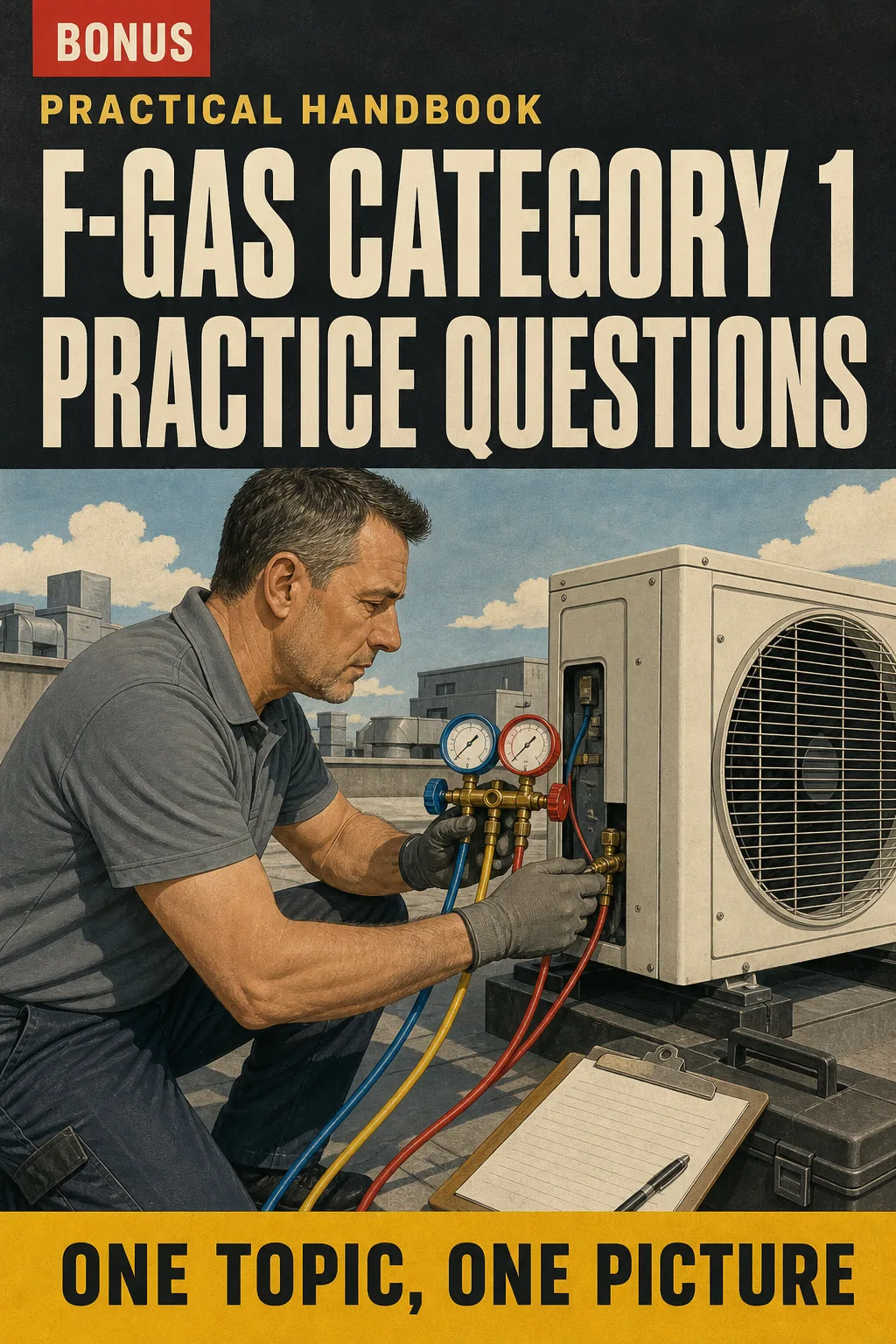
F-Gas Category 1 Practice Questions

BONUS 1: «F-Gas Category 1 Practice Questions»

Value on its own: US$ 17.90

Exam-style questions on the cycle, pressures, leak checks and recovery, each with the answer explained, so you can see what you've got and what needs another look.

The 15 Most Common F-Gas Mistakes

BONUS 2: «The 15 Most Common F-Gas Mistakes»

Value on its own: US$ 14.90

Before-and-after drawings of the most frequent errors, from reading the wrong gauge to skipping the standing vacuum test, so you don't repeat them on the day.

F-Gas Category 1 Illustrated with 2 Free Books

  • F-Gas Category 1 Illustrated: 65 illustrated pagesUS$ 63
  • BONUS 1: F-Gas Category 1 Practice QuestionsUS$ 17.90
  • BONUS 2: The 15 Most Common F-Gas MistakesUS$ 14.90
  • High-resolution PDF to printIncluded
Total value US$ 95.80
YOUR PRICE:
US$ 27
You save US$ 68.80
YES, I WANT F-GAS CATEGORY 1 ILLUSTRATED FOR US$ 27

📄 This is a digital PDF book sent to your email: nothing is printed or shipped.

Secure purchaseEncrypted payment30-day guarantee

PDF by email: We email you F-Gas Category 1 Illustrated as a PDF, together with the two free books. It's a single payment: no installments, no extra charges.

Who This Book Is For

You're studying for Category 1

You're studying for Category 1

Every topic is one drawing, in a fixed order, so you can study a page a night after work and build it up properly.

Your assessment is close

Your assessment is close

The revision part puts the whole cycle, the numbers and the practical sequence in front of you, so you go in knowing the order.

You already work on systems

You already work on systems

Print the pages you need, keep them in the van and check the recovery, vacuum and record-keeping steps on the job.

Everything You Get Today

US$ 95.80US$ 27
YES, I WANT F-GAS CATEGORY 1 ILLUSTRATED FOR US$ 27

📄 This is a digital PDF book sent to your email: nothing is printed or shipped.

30DAYS
GUARANTEE

30-Day Guarantee

Try F-Gas Category 1 Illustrated for 30 days, bonus books included.

We refund everything if the file won't open, if the book isn't what you see here, if you were charged twice or if the email doesn't arrive. Just email us.

You pay once. No subscriptions.

Frequently Asked Questions

Is it for me if I'm a gas engineer moving into heat pumps, or haven't sat an exam in years?

Yes. It starts from the basics, including heat pumps and the reversing valve, and goes straight to what the assessment covers: the cycle, the gauges, superheat, leak checks and recovery, one page each.

Where does the content come from?

It's checked against the F-gas rules in force in Great Britain: Regulation 517/2014 and Regulation 2015/2067 as they apply in GB (now called assimilated law, 'retained' before 2024), the Fluorinated Greenhouse Gases Regulations 2015 (SI 2015/310) and the GOV.UK guidance. The EU 2024/573 rules apply in Northern Ireland, not in GB, and the book keeps them separate.

Is it official material?

No. It's an independent illustrated study book, not issued or endorsed by any government body or certification body.

Does it replace the course or the training?

No. Category 1 still means a theory and practical assessment with an approved body, and the certificate comes from them, not from the book. The book covers both sides: the theory topics, and the practical sequence drawn step by step (connecting the manifold, recovery, strength and tightness test with OFN, standing vacuum test, charging by weight). The hands-on part you still practise on the rig.

Are the practice questions the ones in the assessment?

No. They're written for this book, in the style of the topics covered, with the answer explained for each one.

When and how does it arrive?

As a PDF by email, to the address you enter at checkout. The 2 free books come the same way.

Do I have to pay every month?

No. It's a one-off payment.

Can I have it on paper?

Yes. The PDF is made to print, so you can print the whole book or just the pages you want in the van.

How does the refund work?

You have 30 days. We refund everything if the file won't open, if the book isn't what you see on this page, if you were charged twice or if the email doesn't arrive: just email us.

Before You Close This Page

No more rereading with nothing sticking.

The manifold: you see it drawn and that's it.

You arrive at the assessment knowing where everything is.

Drawings make studying faster.

The book is right below.

One-time payment: US$ 27 · Guarantee: 30 days · PDF by email

YES, I WANT F-GAS CATEGORY 1 ILLUSTRATED FOR US$ 27

📄 This is a digital PDF book sent to your email: nothing is printed or shipped.